CNC Turning vs CNC Milling: Key Differences, Costs & When to Use Each
CNC Turning vs CNC Milling: Key Differences and When to Use Each
When it comes to (CNC machining)"//www.eastmaster.com/en/services/cnc-precision-machining.html", the two most fundamental processes are CNC turning and CNC milling. While both remove material from a workpiece using computer-controlled cutting tools, they operate on completely different principles and excel at creating different types of geometries.
Choosing the right process — or determining when both are needed — directly impacts part quality, cost, and lead time. This guide provides a comprehensive comparison of CNC turning and CNC milling, helping engineers, designers, and procurement managers make informed decisions for their (precision machined parts)"//www.eastmaster.com/en/products.html".
Based on 25+ years of CNC manufacturing experience at Eastmaster Manufacturing in Shenzhen.
How CNC Turning Works(H2)
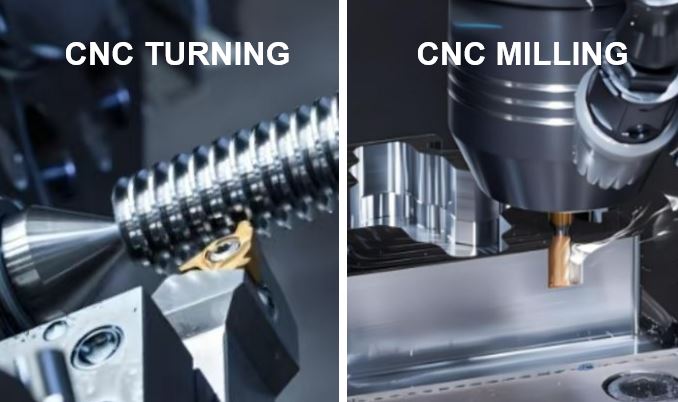
In CNC turning, the workpiece rotates (spins) on a spindle while a stationary or linearly-moving cutting tool removes material. The rotation of the workpiece is the primary motion; the tool moves linearly (in X and Z axes) to create the desired shape.
Key characteristics:
-
Workpiece rotates; tool is stationary or moves linearly
-
Primarily 2-axis process (X and Z) — some advanced lathes have live tooling for secondary operations
-
Produces axisymmetric (round) parts naturally
-
Excellent for external and internal cylindrical surfaces
-
Very high material removal rates for round stock
-
Superior surface finish on diameters (can achieve Ra 0.4 μm or better)
Common operations on a CNC lathe:
-
Facing: Cutting a flat surface on the end of the workpiece
-
OD (Outside Diameter) turning: Reducing the external diameter
-
ID (Inside Diameter) boring: Enlarging or finishing internal diameters
-
Grooving/Parting: Cutting narrow channels or cutting off finished parts
-
Threading: Cutting external or internal threads
-
Taper turning: Creating conical surfaces
-
Knurling: Creating textured grip patterns on the surface
How CNC Milling Works(H2)
In CNC milling, the cutting tool rotates on a spindle while the workpiece remains stationary (clamped to a table). The rotating tool moves along multiple axes to remove material and create the desired geometry. The rotation of the tool is the primary motion.
Key characteristics:
-
Tool rotates; workpiece is stationary or moves linearly
-
3-axis, 4-axis, or 5-axis movement possible
-
Produces complex, non-round geometries — pockets, slots, contours, holes, 3D surfaces
-
Versatile: can machine flat surfaces, complex contours, and angled features
-
Lower material removal rates than turning for simple round features
-
Wider range of possible part geometries
Common operations on a CNC mill:
-
Face milling: Creating flat surfaces
-
Pocket milling: Cutting enclosed or open cavities
-
Slot milling: Cutting channels and slots
-
Profile milling: Cutting external contours
-
Drilling and boring: Creating and finishing holes
-
Contouring: 3D surface machining for complex shapes
-
Engraving: Fine detail work and text
CNC Turning vs CNC Milling: Head-to-Head Comparison(H2)
|
Feature |
CNC Turning |
CNC Milling |
|
Primary Motion |
Workpiece rotates |
Tool rotates |
|
Axes |
2-axis (X, Z) standard; live tooling adds C/Y |
3-axis (X, Y, Z) standard; 4/5-axis optional |
|
Part Geometry |
Axisymmetric (round) parts |
Complex, non-round, prismatic parts |
|
Workpiece Shape |
Bar, rod, tube, pre-formed round stock |
Block, plate, casting, or any shape |
|
Surface Finish |
Excellent on diameters (Ra 0.4+ achievable) |
Good (Ra 0.8-1.6 typical) |
|
Tolerances |
±0.01-0.05 mm on diameters |
±0.02-0.05 mm on features |
|
Material Removal Rate |
Very high for round features |
Moderate to high, depends on geometry |
|
Setup Time |
Generally shorter for simple parts |
Can be longer for complex parts |
|
Cost per Part (simple round) |
Lower |
Higher |
|
Versatility |
Limited to rotational geometries |
Extremely versatile |
|
Feature Examples |
Shafts, bushings, pins, nuts, fittings |
Brackets, housings, plates, molds, enclosures |
When to Use CNC Turning(H2)
Choose CNC turning when your part meets these criteria:
-
The part is primarily round/axisymmetric: Shafts, pins, bushings, fittings, nozzles, and fasteners are ideal candidates.
-
Tight concentricity requirements: Turning naturally produces excellent concentricity between OD and ID features because they are machined in the same setup.
-
High-volume production of round parts: Turning has faster cycle times for rotational geometries.
-
Superior surface finish on diameters: The continuous cutting action of turning produces excellent surface finishes on cylindrical surfaces.
-
Internal features on round parts: Bores, internal threads, and counterbores are easily accessed on a lathe.
-
The raw material is round stock: Bar, rod, or tube — turning starts from round cross-sections and wastes less material.
When to Use CNC Milling(H2)
Choose CNC milling when your part requires:
-
Non-round or complex geometry: Brackets, housings, plates, and any part with flat surfaces, pockets, slots, or contours.
-
Multiple features on different planes: Holes, pockets, and profiles on multiple faces require milling (or 4/5-axis capability).
-
Flat surfaces: Any part requiring precision flat faces should be milled.
-
Complex 3D contours: Sculpted surfaces, molds, and organic shapes require multi-axis milling.
-
Hole patterns: Arrays of holes at specific positions and angles are more naturally produced on a mill.
-
The raw material is block/plate stock: Starting from a block or plate, milling removes material to create the final shape.
When You Need Both Turning and Milling(H2)
Many parts require both turning and milling operations. Common scenarios include:
Parts with Round and Non-Round Features(H3)
A shaft with a flat milled on one side, cross-drilled holes, or keyways needs turning for the cylindrical surfaces and milling for the non-round features. Options include:
-
Sequential operations: Turn first, then mill on a separate machine (requires re-fixturing)
-
Turn-mill center: A single machine with both turning spindle and live milling tools — complete the part in one setup
-
Swiss-type lathe: For small, complex parts with milled features — ideal for medical and watch components
Cost and Quality Considerations(H3)
-
Single-setup (turn-mill center): Higher machine cost but eliminates re-fixturing errors and reduces total cycle time
-
Sequential (two machines): Lower machine cost per operation but adds handling time and potential alignment errors
-
For
Material Considerations for Turning vs Milling(H2)
Both processes can handle the same range of materials — metals (aluminum, steel, stainless, titanium, brass) and (engineering plastics (PEEK, POM, PTFE, Nylon))"//www.eastmaster.com/en/products.html". However, some materials are easier to machine with one process:
-
Free-machining materials (12L14 steel, 6061 aluminum): Excellent in both turning and milling
-
Sticky materials (304/316 stainless, titanium): Turning is generally easier due to continuous cutting; milling requires careful chip evacuation
-
Brittle materials (cast iron, PTFE): Both processes work well; milling may produce better surface finishes on flat faces
-
Hardened steels: Turning with CBN inserts or hard milling — both are viable, chosen based on part geometry
Cost Comparison: Turning vs Milling(H2)
Understanding the cost drivers helps optimize your (CNC machining budget)"//www.eastmaster.com/en/services/tooling-and-moulding.html":
|
Cost Factor |
CNC Turning |
CNC Milling |
|
Machine Hour Rate |
Generally lower (simpler machines) |
Higher (especially 4/5-axis) |
|
Setup Time |
Shorter for simple parts |
Longer for complex parts |
|
Cycle Time (round parts) |
Faster |
Slower |
|
Tooling Cost |
Lower (simple inserts) |
Higher (end mills, drills) |
|
Material Waste |
Lower for round stock |
Higher from block stock |
|
Secondary Operations |
May need milling for non-round features |
May need turning for round features |
Rule of thumb: If the part can be made entirely on a lathe, turning will almost always be cheaper. If milling is required, the cost depends on the complexity and number of setups.
Process Selection Checklist: Turning vs Milling(H2)
-
Part geometry is primarily round/axisymmetric → Turning
-
Part has flat surfaces, pockets, or non-round features → Milling
-
Part requires both round and non-round features → Turn-mill center or sequential
-
Tight concentricity between features → Single setup (turn-mill) preferred
-
Raw material is bar/rod → Turning preferred
-
Raw material is block/plate → Milling preferred
-
High-volume round parts → Turning for efficiency
-
Complex 3D surfaces → 3/4/5-axis milling required
-
Surface finish priority on diameters → Turning
-
Cost optimization → Choose the process that minimizes setups and material waste
Why Choose Eastmaster for CNC Turning and Milling(H2)
Eastmaster Manufacturing operates a comprehensive fleet of CNC turning and milling equipment, allowing us to select the optimal process for every part:
-
CNC Lathes: 20+ machines, from small precision lathes to large swing lathes (up to 500 mm diameter)
-
CNC Turning Centers: With live tooling and Y-axis for complex turned-milled parts
-
3-Axis CNC Mills: For prismatic parts and prototypes
-
4-Axis and 5-Axis CNC Mills: For complex, multi-face machining in a single setup
-
Swiss-Type Lathes: For small, high-precision components (medical, electronics)
-
Material versatility: Full range of metals and
-
ISO 9001 and ISO 13485 certified quality management
-
D-U-N-S verified: 66-849-8033
Whether your part needs turning, milling, or both, our engineering team will recommend the most efficient and cost-effective manufacturing approach. (Contact us)"//www.eastmaster.com/en/contact-us.html" with your drawings for a quick quote — typically within 24 hours.
Comprehensive Analysis of Materials for CNC Machining: Properties and Suitable Products
CNC machined parts with PTFE impregnated hard anodizing: ALTEF/ANO-LUBE/Hardcoat/SLF 74/16 COATING