


PTFE Impregnated Hard Anodizing for Aluminum Parts
No inventory maintained.
All intellectual property and designs remain the exclusive property of the original client.
We never resell custom products to third parties.
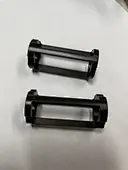
Our PTFE impregnated hard anodizing process (also known as ALTEF coating or Teflon anodizing) creates aluminum parts with an ultra-low friction, wear-resistant surface. PTFE is embedded directly into the hard anodic layer, combining the hardness of Type III hard anodizing with the lubricity of PTFE.
Key Benefits:
•Friction reduction: 50% lower coefficient of friction vs. standard hard anodizing
•Extended life: 3X longer wear life in sliding and rotating applications
•Self-lubricating: No external lubrication needed in most applications
•Corrosion resistant: Sealed surface resists chemicals, saltwater, and environmental exposure
•High temperature: Continuous service up to 260°C (500°F)
Specifications:
Parameter | Value |
Coating Type | PTFE impregnated Type III (hard) anodizing |
Coating Thickness | 25–75 μm (1–3 mils) standard; up to 125 μm available |
Hardness | 50–60HRC (Rockwell C) |
Friction Coefficient | 0.05–0.15 (dry sliding against steel) |
Operating Temperature | -200°C to +260°C (-328°F to +500°F) |
Color | Dark gray to black (natural color of PTFE-impregnated coating) |
Substrate Materials | Aluminum 6061, 7075, 6083, and other alloys |
Surface Finish | Ra 0.4–0.8 μm as-coated; can be polished lower if needed |
Performance Comparison
PTFE Anodizing vs. Standard Anodizing vs. Hard Anodizing
Property | Standard Anodizing (Type II) | Hard Anodizing (Type III) | PTFE Impregnated Hard Anodizing |
Thickness | 5–25 μm | 25–75 μm | 25–75 μm |
Hardness | 30–40 HRC | 50–60 HRC | 50–60 HRC |
Friction Coefficient | 0.4–0.6 | 0.3–0.5 | 0.05–0.15 |
Wear Resistance | Good | Excellent | Excellent + Self-lubricating |
Lubrication Required | Yes (for moving parts) | Yes (for moving parts) | No (self-lubricating) |
Corrosion Resistance | Good | Excellent | Excellent |
Temperature Range | -40°C to +150°C | -200°C to +200°C | -200°C to +260°C |
Typical Applications | Decorative, light protection | Wear parts, tooling | Sliding/rotating parts, high-wear applications |
Application
Where PTFE Anodized Aluminum Excels
Aerospace & Defense
•Landing gear components – PTFE coating reduces friction in pivot points and bushings
•Actuator housings – Self-lubricating surface eliminates need for grease in clean environments
•Guides and rails – Smooth sliding motion without external lubrication
•Missile guidance parts – Low friction, high reliability in extreme temperatures
Automotive & Transportation
•Piston skirts – Reduces friction against cylinder walls, improves efficiency
•Gear housings – Extends life in high-wear transmission components
•Brake system parts – Corrosion resistant, performs in wet conditions
•Fuel system components – Resists chemical exposure from fuels and additives
Industrial Equipment
•Conveyor guides and rails – Low friction reduces drive power requirements
•Packaging machine parts – Clean, non-stick surface for food and pharmaceutical applications
•Textile machine components – Smooth surface prevents fiber adhesion
•Bearing housings and bushings – Self-lubricating, maintenance-free operation
Medical & Scientific
•Surgical instrument housings – Autoclavable, non-stick, easy to clean
•Laboratory equipment – Chemical resistant, cleanable surface
•Adjustable fixtures – Smooth adjustment without lubrication contamination
Advantage | What It Means for You |
In-house CNC machining + Anodizing nearby | We machine parts in house and do finish nearby – faster turnaround, better quality control |
25+ Years Experience | Established in 2001, we've delivered thousands of anodized aluminum parts globally |
ISO 9001 + ISO 13485 Certified | Quality management you can verify; critical for aerospace and medical applications |
Low Volume Expertise | MOQ 1 piece – perfect for prototypes, R&D, and small production runs |
Fast Turnaround | CNC machining 1–5 days + anodizing 1–2 days = complete parts in 2–7 business days |
Global Experience | Serving customers in 30+ countries; English-speaking engineering team |
Quality Documentation | Dimensional inspection reports, coating thickness measurements, and material certificates included |
FAQ:
Q1: What is the difference between PTFE anodizing and regular Teflon coating?
A: PTFE anodizing (ALTEF coating) embeds PTFE into the hard anodic layer, so it's mechanically locked in and won't peel or wear off easily. Regular Teflon coating (PTFE spray) is applied on top of the surface and can wear away over time. PTFE anodizing is much more durable for high-wear applications.
Q2: Can PTFE anodized aluminum be used in food contact applications?
A: Yes, PTFE anodized aluminum is FDA-compliant and suitable for food contact applications. The sealed, non-stick surface is easy to clean and resists bacterial growth. Common uses include packaging machine parts, food processing equipment, and bottling line components.
Q3: What colors are available for PTFE anodizing?
A: PTFE anodizing naturally produces a dark gray to black color due to the embedded PTFE particles. Unlike standard anodizing, it cannot be dyed other colors because the PTFE occupies the pores that would normally hold dye. If you need color + low friction, we can do standard color anodizing on non-wearing surfaces and PTFE anodizing on wearing surfaces.
Q4: How thick is the PTFE anodized coating?
A: Standard thickness is 25–75 μm (1–3 mils). For extreme wear applications, we can achieve up to 125 μm (5 mils). The coating thickness is controlled precisely to maintain part dimensions within your specified tolerances.
Q5: Can you PTFE anodize aluminum alloys other than 6061?
A: Yes, we work with 6061, 7075, 6083, and other aluminum alloys. Note that different alloys may produce slightly different coating appearance and thickness. 7075 anodizes well but may show a slightly darker color. We'll recommend the best alloy for your application.
Q6: What is the lead time for PTFE anodized parts?
A: Typical lead time is 5–10 business days: CNC machining (1–5 days) + PTFE anodizing (1–2 days) + shipping (3–5 days). Rush orders can be completed in 3–5 days for simple parts.
Q7: Do you provide quality documentation?
A: Yes. Every order includes a dimensional inspection report. We can also provide coating thickness measurements, hardness test results, and material certificates (EN 10204 3.1) upon request.
Related Products & Services
Looking for more? Check out our other capabilities:
•CNC Precision Machining – High-precision metal and plastic parts
•5-Axis Machining – Complex geometry parts
•CNC Machined Aluminum Housing– Custom enclosures and housings
•Non-metallic Machined Parts – PTFE, PEEK, Delrin, UHMW-PE parts
•Rapid Prototyping – Fast prototype production
•View All Products – Browse our complete product range
Get a Quote for PTFE Anodized Aluminum Parts
Ready to order?
Send us your drawings for a free quote within 24 hours. We'll review your design, recommend the optimal coating thickness, and provide a detailed quotation.
Email: info@eastmaster.com
Phone:+86 755 22676100
WhatsApp / WeChat available on the right side.